tCPA and tROAS Are Getting a Makeover. Here Is What to Do Before 17 August
If your budget-limited campaigns have been beating their tCPA or tROAS targets, Google will start enforcing the number in settings from 17 August. Here is what to review and adjust before the deadline.

 Ana Kostic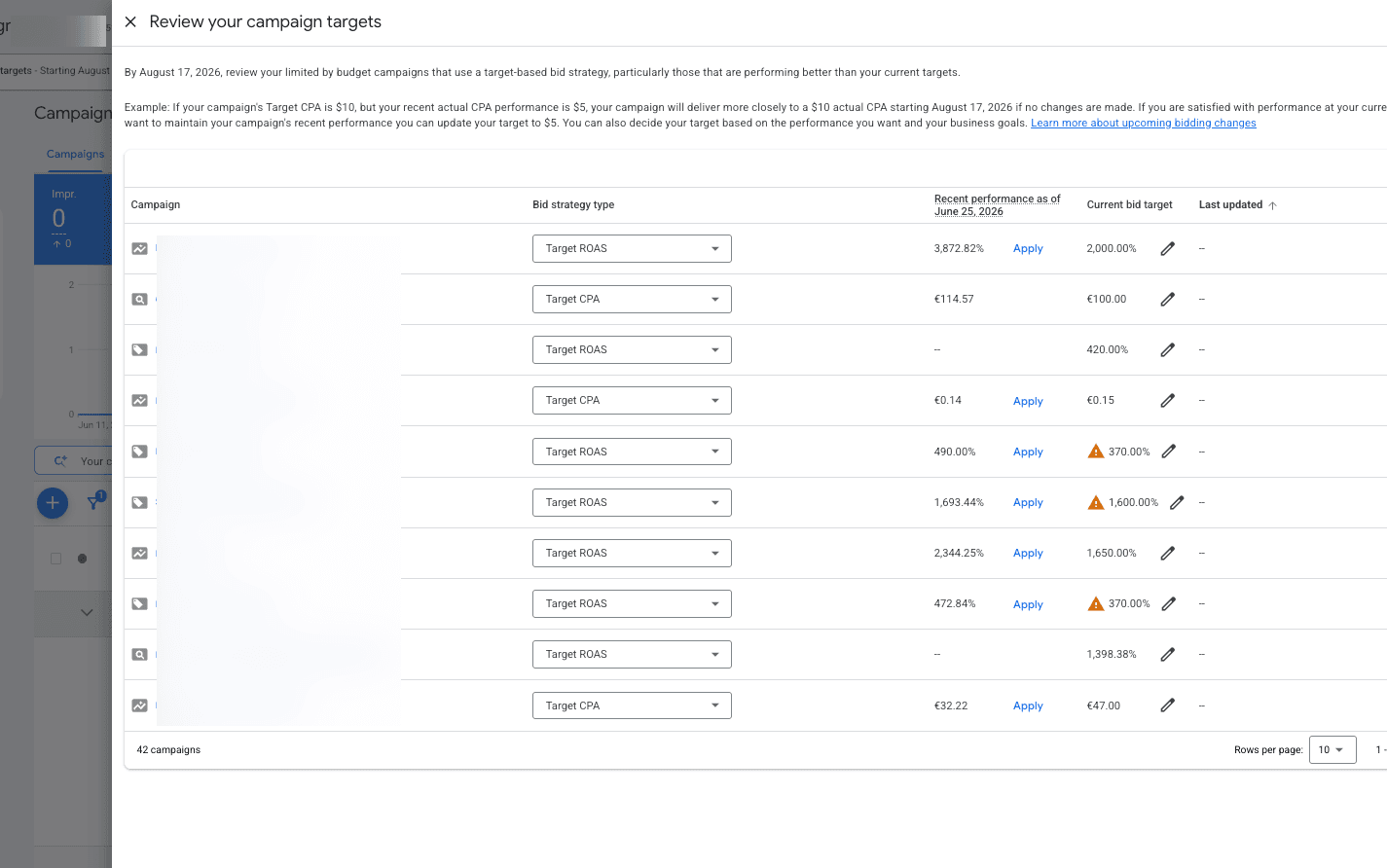
Google has announced a change to how Target CPA (tCPA) and Target ROAS (tROAS) work in campaigns marked Limited by budget. The update rolls out from 17 August 2026.
Until now, many budget-limited campaigns on target-based bidding have outperformed the number in settings, actual CPA below target CPA, actual ROAS above target ROAS. Google says that from 17 August, the system will optimise more consistently toward the target you configured, including when you adjust budget.
In one line: the target you leave in place becomes the performance the system will aim for more seriously.
Why this matters in live accounts
Target CPA and Target ROAS become a stricter instruction to the algorithm.
If you set a target CPA of £40 months ago and the account has been running closer to £22, the system may bid differently to move delivery toward £40. Same daily budget. Different efficiency. Or fewer conversions for the same spend, depending on how the campaign is set up.
Google will not automatically change your targets or budgets. What changes is the bidding logic behind the scenes. If the target is stale, the account can look healthy in a report while the instruction you left in place no longer matches what you want.
The timeline
| Date | What happens |
|---|---|
| 6 July 2026 | Bid Target Adjustment Tool available in eligible accounts, plus in-account notifications if you are affected. |
| 17 August 2026 | New bidding behaviour applies to budget-limited campaigns using tCPA or tROAS (and Target CPC on Demand Gen). |
A numbers example
Target CPA: £10
Recent actual CPA: £5
Status: Limited by budget
If you change nothing, Google’s published guidance states the campaign will tend to deliver closer to £10 than £5 after 17 August. To stay around £5, lower the target before the deadline.
Which campaigns are in scope
This applies to budget-limited campaigns using target-based bidding across Search, Shopping, Performance Max, Demand Gen and Travel (plus Demand Gen in Display & Video 360).
Not affected in the same way: App campaigns, video reach, and video view campaigns (VVC). Hotel and Display already use the updated behaviour.
In Performance Max and Demand Gen, Google also flags possible shifts in how spend is distributed across channels, not just CPA or ROAS at campaign level.
Campaigns on tCPA or tROAS that are not budget-limited should behave as they do today.
What Google says will not happen
Three clarifications worth separating from the headline panic:
- No automatic target edits. Your CPA, ROAS and budget stay where you put them unless you change them.
- No automatic spend increase on an already budget-capped campaign. The daily cap still holds. What can move is efficiency, not necessarily total spend.
- More predictable scaling at a stated target is Google’s stated reason: less drift when you raise or lower budget on a constrained campaign.
The reaction on socials
There has been a fair amount of noise on LinkedIn since the announcement: concern, in some cases outright indignation, that Google is “punishing” advertisers or pushing the system’s interests over ours.
That reaction is understandable. Platform changes do not always land in our favour, and years of surprise rollouts have trained us to read the worst into any bidding update.
In this case, though, Ginny Marvin (Google Ads Liaison) has been clear in public threads about the mechanics: the system sets bids to find as many conversions as possible at the target you set and keep average CPA or ROAS equal to that target. Budget-limited campaigns with targets were an exception; from 17 August they are brought in line with that behaviour. She has also separated this from budget changes explicitly: you do not spend more unless you increase budget. If you want to keep your current average efficiency, change the target.
That level of transparency does not erase the workload on our side. But it does mean we know what the rules are and what we need to do.
So where do I stand?
Honestly, I do not see this as an unambiguously positive change. For years, budget-limited campaigns that beat their targets have been quietly useful. A campaign set to 900% ROAS delivering 1,800% has been often how constrained campaigns actually behave, and that headroom works in the advertiser's favour.
The trade-off is one practitioners already know: scaling becomes harder to read. When budget, not the target, is effectively regulating performance, you cannot trust the number in settings as a planning anchor. Raise budget and you do not know whether delivery will scale at your stated target or at the efficiency the algorithm had been finding on its own.
On that point, I think Google has a fair argument. Bringing budget-limited campaigns in line with the stated rule, optimise toward the target you set, does make the system more predictable when you change budget. Budget controls volume; the target controls efficiency. The rules of the game become clearer. That is a reasonable design choice, even if it is not one we were asked to vote on.
Am I reassured? Partly. The explanation is clear enough to act on. What is less reassuring is the asymmetry, Google announces, we adapt, which is familiar but never pleasant.
Do I expect issues in live accounts? Yes, especially during the adjustment window. The accounts most at risk are not the ones managed daily by dedicated PPC teams. They are the ones where targets were set once and never revisited, or where the person running ads has ten other jobs and may not realise this update applies to them.
For people who work in this field and stay on top of their accounts, we have been given the playbook. I do not think this breaks performance in the long run if we do our part, align targets to the efficiency we actually want, adjust gradually, and watch what happens after 17 August. If we skip that work, the system will treat stale targets as live instructions. That is where the damage will show.
My read: a necessary correction from Google's perspective, a short-term headache for advertisers, and a long-term neutral-to-positive shift only if targets are treated as active controls rather than legacy labels. I cannot fight Google's decisions. What I can do is analyse the situation and adapt accordingly.
Who is most exposed
This only affects campaigns marked Limited by budget on tCPA or tROAS. If you do not have campaigns in that state, or only one or two, this is not something to lose sleep over. If you do, it deserves a proper audit.
In my accounts, I am prioritising in this order:
- Performance Max, often budget-limited, often on tROAS, and frequently with large gaps between configured target and recent actual. Google has also flagged possible channel mix shifts inside PMax, not just campaign-level ROAS.
- Search, high performance expectations, frequent budget caps on core terms, and targets that may have been set months ago against a different competitive landscape.
- Demand Gen, same underlying logic, worth watching, though typically lower on my priority list than Search and PMax.
What I would raise with clients now
With clients who have budget-limited tCPA or tROAS campaigns, I would start the conversation this week. Transparency is always the best approach, but transparency without a plan leaves everyone shaky (so make a plan).
What I would cover:
- Scope: This only affects campaigns marked Limited by budget on target-based bidding. If that is not their account, say so plainly.
- Mechanism: Google is not changing settings for us. Bidding logic will honour configured targets more consistently.
- Risk: Campaigns beating their targets may drift toward the number in settings. That can look like a performance drop even with unchanged budget.
- Plan: We will audit the gaps, adjust targets in controlled steps before 17 August, and monitor for one to two conversion cycles after.
If current metrics are already better than target, I would set expectations early: we are not chasing a Google-imposed downgrade for its own sake. We are making sure the instruction in the account matches the performance we intend to keep. Adjusting targets may cause fluctuation. We will try to minimise it, but it may happen, and it is better to manage that deliberately than to be surprised in August.
What I am doing in accounts this week
Export and segment
From the account or MCC, I download campaign data for the last 30, 90 days and filter to:
- Status reason: Limited by budget
- Bid strategy: Target CPA or Target ROAS
I split tROAS and tCPA into separate sheets. Different mental models, different conversations.
Compare target vs actual, with conversion lag in mind
For each campaign, I compare configured target to recent actual CPA or ROAS. But I check conversion lag first.
If 95% or more of conversions happen same-day, last-30-day data is fine. If a meaningful share converts after seven days or more, I do not rely on the last seven days alone. I use a window like days 8, 37, or whatever matches the account's full lag, so I am not adjusting off incomplete data.
Flag the gaps that matter
I highlight campaigns where actual performance is better than target. Those are the priority list.
Build an adjustment schedule, not a one-shot fix
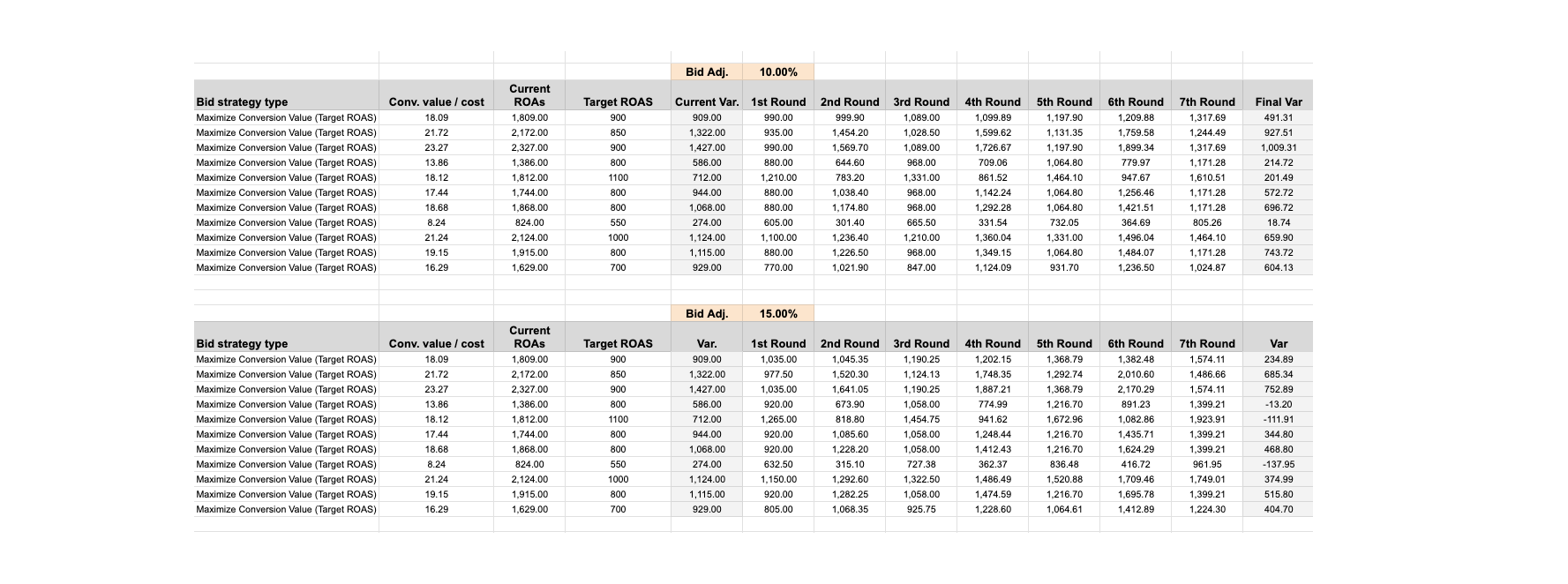
Do not change every target at once, and do not make changes greater than 20% in either direction. Large jumps destabilise learning; budget-limited campaigns under constraint do not need extra disruption.
My default is around 10-15% per adjustment cycle, spread over more rounds, rather than 20% compressed into fewer weeks. I wait at least one full conversion cycle between changes. On accounts where conversions complete in one or two days, that might mean adjusting every three or four days. On accounts with a seven-day conversion cycle, roughly weekly.
With a 17 August deadline, shorter lag windows allow more cycles before the rollout; longer lag may mean prioritising the worst gaps first. I
Also, do not change budget drastically at the same time, one variable at a time.
After 17 August, plan to keep one or two test campaigns on a slightly more aggressive step, say 20% versus 10%, to learn how the new logic behaves in practice. Controlled learning is always a good practice.
Document before and after
For client or internal records: campaign, target before, actual before, adjustment plan, date changed, performance after one to two cycles. If August numbers move, someone will ask why.
A worked example: modelling the adjustment path
What I will watch once the change goes live
Once the new behaviour is active, these are the signals I care about:
- Efficiency drift on priority campaigns: especially PMax and Search where actual targets had been far above target.
- Volume at unchanged budget: Confirm conversion volume does not collapse unexpectedly.
- Channel mix inside PMax and Demand Gen: campaign-level ROAS might change and Search, Shopping or Display allocation shift.
- Auction expansion: If the system pushes toward target by bidding into auctions we were previously skipping, efficiency and volume could both move in ways the announcement does not fully describe.
- Whether the ramp is gradual, my assumption is the system will not snap to target overnight on 17 August. I expect a period of adjustment. I will verify that against data.
Tl-DR
- From 17 August 2026, budget-limited tCPA/tROAS campaigns should optimise more consistently toward the target in settings.
- Google will not change targets or budgets for you.
- Campaigns that looked "better than target" may drift toward the configured number, treat that as misaligned settings.
- My read: not a gift to advertisers, but a clarifying change; painful if ignored, manageable if you treat targets as live instructions.
- Most exposed: budget-limited PMax and Search on tROAS/tCPA, especially where actual performance beats target by a wide margin.
- Before 17 August: export, segment, model adjustment cycles (no more than ~20% per step, lag-aware), talk to clients with a plan and document everything.
- After 17 August: monitor efficiency, volume, channel mix, and test a small subset before rolling aggressive changes account-wide.
The target you leave in place becomes the performance the system will aim for more seriously. The work now is making sure that instruction matches what you actually want.
Sources & Further Reading
- Changes to target based bid strategieshttps://support.google.com/google-ads/answer/17061251?hl=en
- FAQ: Changes to Target-based bid strategieshttps://support.google.com/google-ads/answer/17125145?hl=en
- Search Engine Roundtable: Ginny Marvin clarification on budget-limited biddinghttps://www.seroundtable.com/google-ads-bidding-campaigns-limited-budget-41618.html